

The Ruin That Won
On two piers, and why the broken one draws a bigger crowd.

There are two piers in Brighton & Hove. One of them is alive – just. It’s got rides, an arcade, doughnut stands, a fortune teller, gift shops. It’s also got a sign that says “investing in the present to preserve our heritage,” printed in mismatched colourful font over a chaotic background image of itself. It costs money to walk on.
The other one is inaccessible, because it burned down. Not once but twice in 2003, both times believed to be arson. I remember running down to the beach with two friends to pay our respects as the flames engulfed it.


Yesterday I realised it had been too long since I’d seen a murmuration, so I decided to head to the beach at sunset. After an outrageously wet winter it finally felt like spring was on its way, and hundreds of people had had the same idea as me.
The murmuration was spectacular as ever, but I couldn’t help noticing where else people were looking. Where they were pointing, what they were photographing.
The West Pier. Once THE pier, now just two skeletal frames standing in the sea like something from a fever dream, drawing the eye in a way the working pier doesn’t. At dusk the murmurations swarm around it, thousands of starlings moving as one body, and strangers stop and stand together to watch, telling ghost stories passed down from their grandparents.
Brighton Palace Pier, by contrast, has been up for sale since the beginning of the year. The new name hasn’t stuck. Nothing there seems to quite stick. I wandered onto it yesterday out of curiosity, and saw a sign that I’ve been thinking about ever since. Investing in the present to preserve our heritage. What heritage, exactly? Because I’ve walked that pier plenty of times and I’ve never once seen or felt any sign of heritage. I don’t know whose stories it’s holding close, or what it was before it was this.
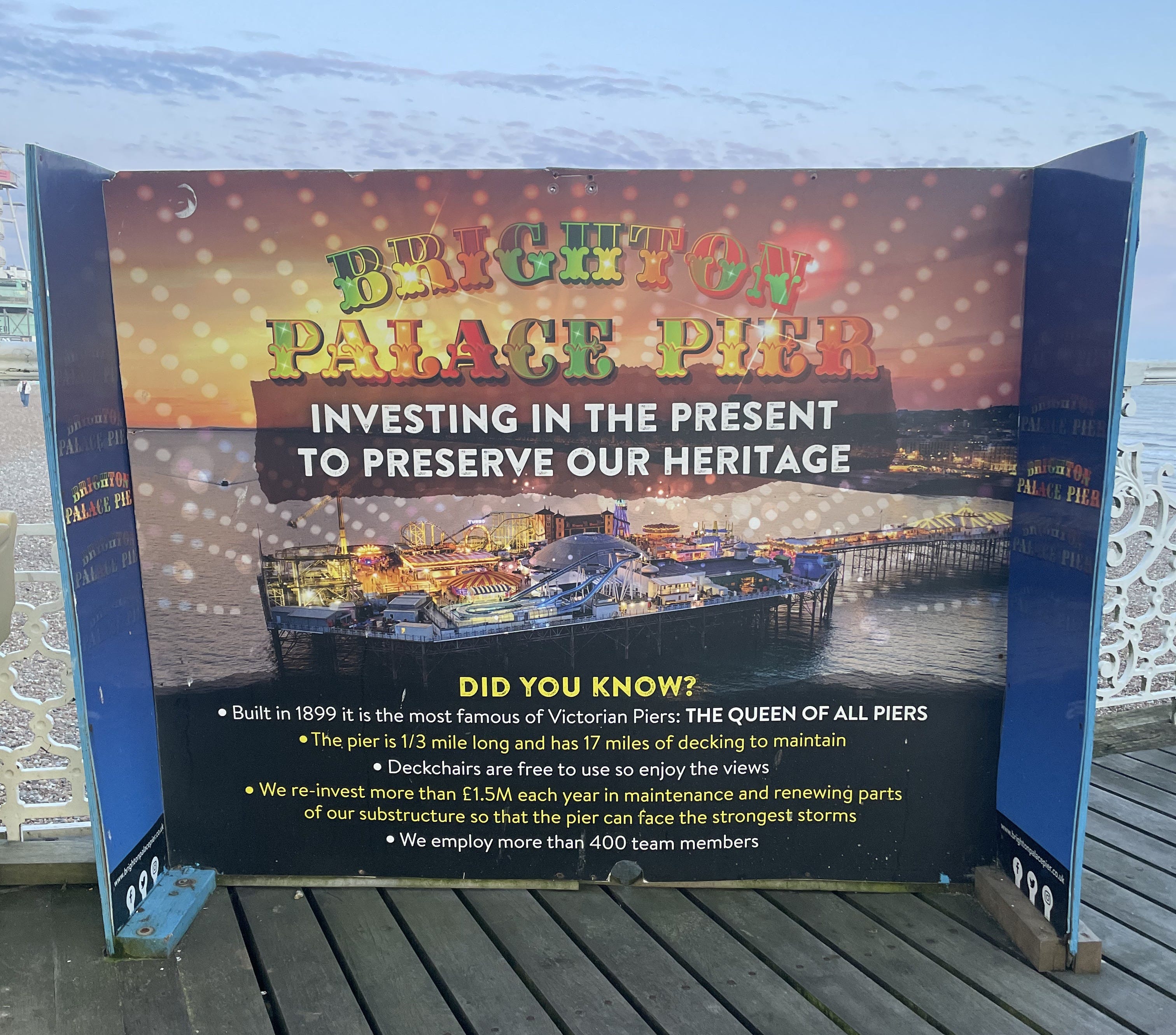
It’s not that the history isn’t there. The Palace Pier opened in 1899 and survived two world wars. There’s over a century of Brighton in its bones, but none of that is being offered to you when you pay for entry. Instead you get a defensive tagline in an indecisive font, overlaid on stock imagery.
The West Pier isn’t trying. It’s just itself, without apology. It’s a ruin stripped back to its structure, indifferent to whether you find it beautiful or unsettling or both. It doesn’t have a strategy, just a silhouette. And that silhouette has become one of the most photographed, painted, written-about images in Brighton, probably in the country.
I live here in Brighton. I walk past both piers regularly; yet when I want an actual pier experience, I drive to Eastbourne. There’s a tea room on the pier there with chandeliers and mismatched crockery and a faint air of gentle absurdity, and I sit in it with a cream tea and feel connected to the sea, to the history of the place. It costs less than the Brighton one, but it knows what it is.
A place that knows what it is gives you something to hold on to. Something to come back for. The West Pier knew what it was even before it burned: a Victorian pleasure palace, a place of promenading and possibility. The ruin tells the story more clearly than the original structure ever could.
What’s missing from the working pier isn’t investment: it’s a story. And nobody’s job right now is to tell it. Without an identity and a story to tell, you can invest in the present all you like. You’ll still just be selling doughnuts.
I help living landmarks and cultural institutions uncover their identity and tell their story. Get in touch: rose@roseradtke.co.uk
Please can someone give you the job to make the working one less shit!